Solid Particle Erosion (SPE) of alumina ceramic, epoxy resin, and polymer composites: material removal mechanisms and erosion rate


Dr. Mahdi Nekahi
The Toronto Metropolitan University (TMU) was founded in 1948.
The Department of Mechanical, Industrial, and Mechatronics Engineering focuses on innovative research to develop creative solutions to the world’s most urgent challenges.
Understanding solid particle erosion at the microscale through high-resolution 3D surface metrology is key in designing more durable materials and equipment.”
Solid Particle Erosion (SPE) is a critical degradation mechanism in many industrial applications, as it is a leading cause of component failure, efficiency loss, and increased safety risks. Its impact is specifically significant in high-performance sectors such as energy and aerospace, where materials are routinely exposed to harsh operating conditions.
Understanding how SPE affects materials could help engineers develop tougher materials, optimize operating conditions, and design components resistant to wear from high-velocity particle impacts. Impacts of small solid particles on a target that lead to material removal are known as SPE. SPE, thus, occurs when a surface is subjected to a jet of high-velocity solid particles.
This phenomenon is particularly undesirable in industries that handle particulate flows. Some examples include propulsion systems (such as aircraft engine blades and water turbines), power generation equipment exposed to flue gases (cyclones, furnaces, boilers), and oil and gas infrastructure (pipelines, elbows, and valves). A deeper understanding of SPE behavior is essential for developing more erosion-resistant materials, optimizing operating conditions, and improving the durability and reliability of critical components.
Therefore, understanding the mechanisms and factors that contribute to SPE is critical in designing more durable materials and equipment. For this reason, erosion tests are the key to understanding how it could impact materials. These tests were performed on bulk alumina ceramic, neat epoxy resin, and alumina particle-reinforced polymer composites, using a commercial micro-abrasive blaster in the AJM lab at TMU.
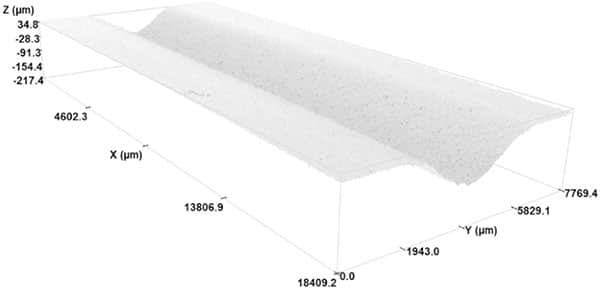
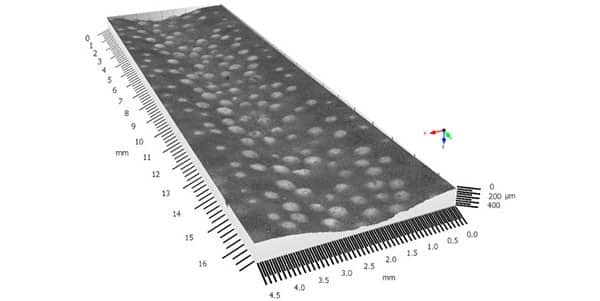
Some of the parameters that are more critical for SPE are the volumetric erosion rate, defined as the volume removed from the target per the abrasive mass used in the erosion test. This parameter was measured at various jet angles (30°, 45°, 60°, and 90°). To measure the volume removed by the eroded channels, a high-resolution non-contact 3D optical profilometer, S neox, was used across the entire surface of the eroded channel. Typical eroded channels scanned by S neox are shown below.
MEASUREMENTS
The figures presented in this study were obtained using a high-resolution, non-contact 3D optical profilometer, primarily operating in Focus Variation mode. This technique enabled detailed three-dimensional characterization of eroded surfaces, including erosion channels, cross-sectional profiles, local material removal mechanisms, and surface morphology under different impact angles and velocities.
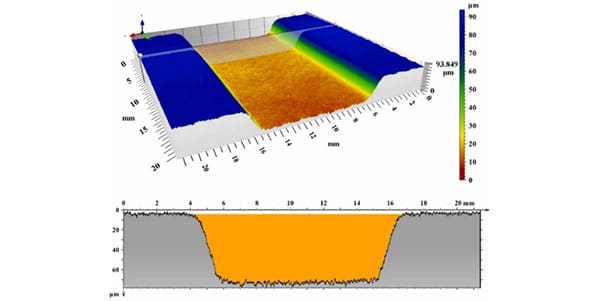
This topography shows an alumina channel generated using the nozzle oscillation technique, together with its cross-sectional profile, where the colored area indicates the eroded region.
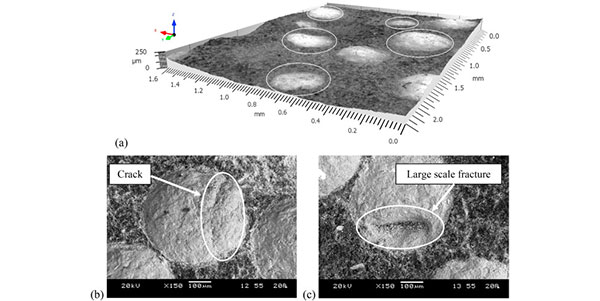
3D topography of a composite material reinforced with 35 vol% alumina particles (447 µm) shows the eroded surface, revealing the mechanisms of surface damage induced by erosion and the interaction between the matrix and the ceramic reinforcements.
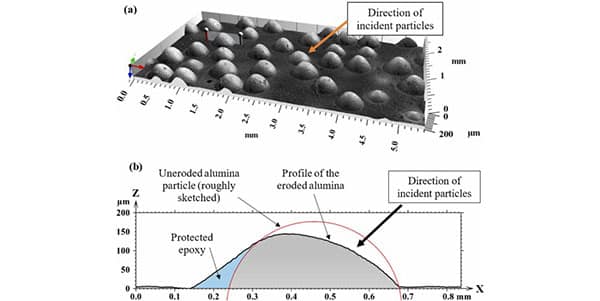
This image shows the composite surface after erosion at 113 m/s and a 45° impact angle. The arrow indicates the direction of the incoming abrasive particles, while the corresponding cross-section highlights the shadowing effect, where the eroded alumina reinforcement partially protected the underlying epoxy.
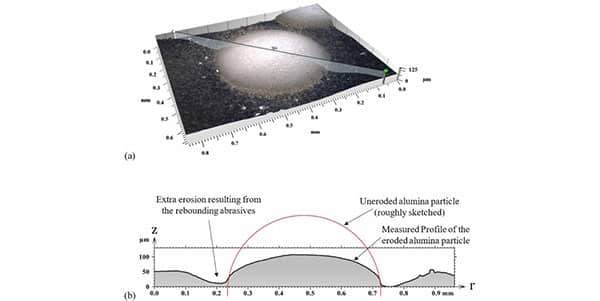
The profilometry image shows the eroded surface of a single reinforcement particle with the matrix eroded to a depth of approximately one particle radius, and the measured cross-sectional profile.
In addition, simulated surface data generated using LS-DYNA and COMSOL were imported into the same system in XYZ format, enabling direct comparison between experimental measurements and numerical predictions.
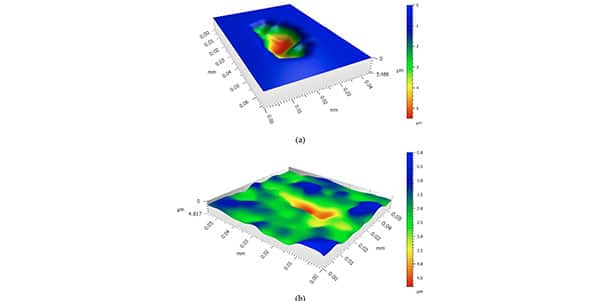
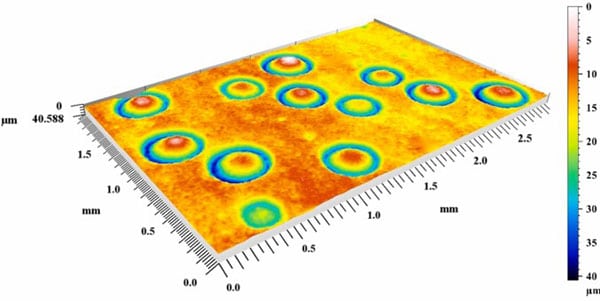
The topographies illustrate the microchipping removal mechanism produced by a single impact of a 152-micron abrasive particle at a 90º angle. The impact event was simulated in LS-DYNA, and the resulting surface was imported into S neox as XYZ data and measured in Confocal mode, enabling direct comparison between the simulated and experimentally captured surface response.
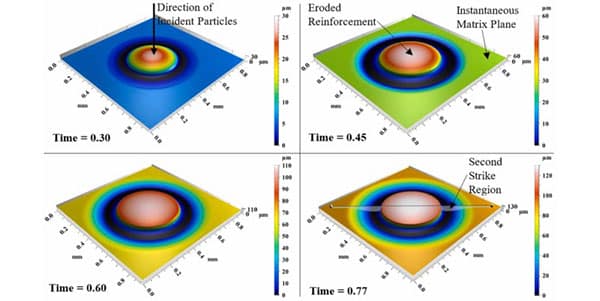
This figure presents the predicted surface evolution of an alumina bead embedded in an epoxy matrix under erosion by fine SiC abrasive particles at a 90º jet angle. The erosion process was simulated in COMSOL, and the resulting surface data were imported into S neox as XYZ files, enabling detailed 3D visualization and analysis of the erosion patterns.
The study successfully achieved a comprehensive quantitative and qualitative characterization of solid particle erosion (SPE) in bulk alumina, neat epoxy resin, and alumina-reinforced polymer composites under different impact angles and velocities. The team of researchers accurately measured erosion channels, cross-sectional profiles, and volumetric material removal, enabling the reliable determination of erosion rates and the clear identification of dominant surface-damage mechanisms, including micro-abrasion, micro-chipping, and shadowing effects caused by reinforcing particles.
All measurements were performed using the S neox, high-resolution non-contact 3D optical profilometer, primarily operating in Focus Variation mode, complemented by Confocal measurements when required. The system provided precise three-dimensional surface reconstructions of eroded features.
It allowed direct import and visualization of simulation data from LS-DYNA and COMSOL, enabling robust comparison between experimental results and numerical predictions.
Sensofar’s S neox proved to be the most suitable solution for this study, with the ability to accurately capture complex erosion geometries, quantify small material losses, and seamlessly integrate experimental and simulated data, making it an essential tool for reliably analyzing solid.
References
[1] Nekahi, M. M., Amin Javaheri, B., & Papini, M. “Erosion modeling of epoxy composites reinforced with angular particulate alumina: A surface evolution approach.” Tribology International (Elsevier), 110895.
[2] Nekahi, M. M., Villasenor Vazquez, E., & Papini, M. “Prediction of the gradual solid particle erosion of particulate-reinforced epoxy-matrix composites using surface evolution modeling.” Tribology International (Elsevier), 109422.
[3] Nekahi, M. M., Villasenor Vazquez, E., & Papini, M. “Numerical modeling of the erosion of alumina particulate reinforced epoxy-matrix composites: Material removal mechanisms including reinforcement fracture.” Wear (Elsevier), 204710.
[4] Nekahi, M. M., Vazquez, E. V., & Papini, M. “Numerical Simulation of Solid Particle Erosion of Alumina by Overlapping Irregular-Shaped Particle Impacts.” Tribology Letters (Springer), 70(2), 1-19.
[5] Arani, N. H., Eghbal, M., Nekahi, M. M., & Papini, M. “Numerical and experimental investigation of the erosion of zirconia particulate-reinforced epoxy matrix composites by angular silicon carbide particles.” Polymer Composites (Wiley), 42(1), 220-235.


Related products