
PERIPHERAL STENTS
As opposed to coronary stents, peripheral stents are self-expandable devices, and these are not implanted using a balloon. These devices are made of Nitinol and have sizes significantly larger than coronary, with diameters ranging from 3mm up to 10mm and lengths ranging from 60mm to 200mm. The measurement of peripheral stents can be performed with our systems.
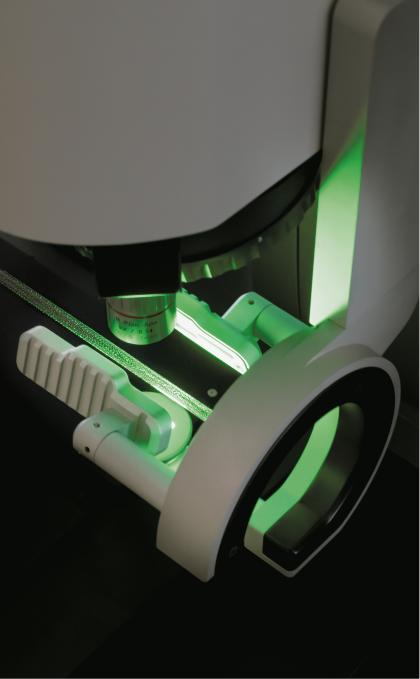
Simultaneous Strut Width Measurement and Visual Inspection
The hardware and software of Sensofar Medical’s inspection systems have been designed to perfectly accommodate a stent’s cylindrical geometry, offering a unique combination of automatic dimensional measurement and visual inspection that radically increases inspection throughput to keep up with production requirements.
Q vix can perform a complete inspection of large peripheral stents; it can achieve an inspection time of 10 minutes on the complete inspection of a 7mm OD and 150mm length, including dimensional measurement on hundreds of positions and automatic visual inspection of the outer and inner surfaces.
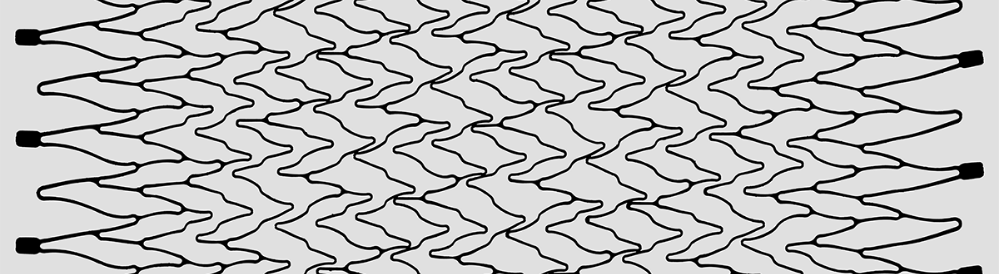
Structural deformation
During the manufacturing of peripheral stents, these are manually positioned on a metallic mandrel before a heat treatment process that gives them the final shape, making deformation control a critical step of the inspection of these devices.
Sensofar Medical has designed assisting tooling for manual and unmanned insertion of mandrels in peripheral stents in a consistent way, reducing false deformation detection coming from the mandrel insertion.
During the manufacturing of peripheral stents, these are manually positioned on a metallic mandrel before a heat treatment process that gives them the final shape, making deformation control a critical step of the inspection of these devices.
Sensofar Medical has designed assisting tooling for manual and unmanned insertion of mandrels in peripheral stents in a consistent way, reducing false deformation detection coming from the mandrel insertion.
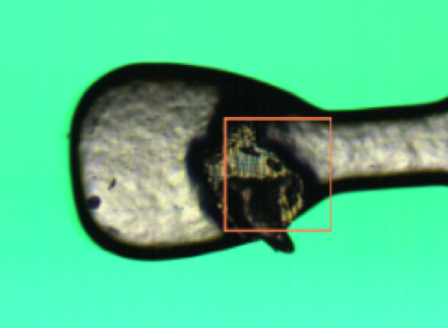
Visual inspection of stent markers
In order to provide a complete inspection and measurement of peripheral stents, specific analysis can be applied to the radio-opaque markers in the ends of the devices, enabling the detection of specific defects that are unique to these areas.
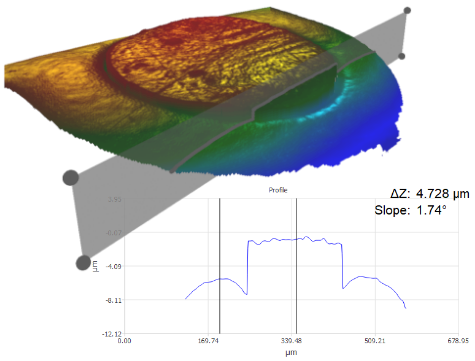
Inspection of stent markers in 3D
Thanks to Q vix 3D mode, it is possible to measure the width of the step between the marker and the stent surface with nanometric accuracy to inspect the insertion process or the welding points on the radio-opaque markers.

Get answers to your questions!
Connect with an expert
Connect with an expert
Just write us an email or search for
a direct contact near you.
a direct contact near you.





Get answers to your questions!
Connect with an expert
Connect with an expert
Just write us an email or search for
a direct contact near you.
a direct contact near you.